Friday, October 10, 2014

Here Comes the Sun

Looking forward to a sunshine-y day tomorrow.  After two days of grey skies and nearly constant precipitation, we are giving our solar array/deep cycle batteries their first real test. 

Good news: despite a lack of sun, and the fact that we have been continuously charging cell phones  and laptops, playing the stereo 24/7, (it's how we get our weather warnings), and operating the lights and fans in the trailer, the batteries are still holding at 12.2 volts.  The lowest voltage that we have observed during this period was 11.8 volts.  Due to the high wattage of our panels, and the judicious use of our electrical resources, we have proven that we can maintain an adequate power supply despite a lack of full sun.

Between our sustainable electricity supply and our Propane Tank Wood Stove, we are warm, safe and connected to the world.

Signing off for the night with a picture of me and Nicci, one of our Great Pyrenees pups, 16 days old.  The other pup is Buttercup...one of Nicci's sisters.

Horsey dreams and Chardonnay kisses.

Cece

Thursday, October 9, 2014

Rainy Day (Pioneer) Women

As the 40° rain comes down outside, I sit here warm and cozy, catching my breath and reflecting upon recent events as Dubs concocts his next masterpiece. 
 
He's working on designing a large kennel for the dogs, complete with its own heating system.  But what is really special about this kennel will be the choice of building materials.  He explained to me that he plans to build the kennels with walls made from concrete and repurposed aluminum beverage cans.  He built a small test wall using plain mud and cans at our previous residence as "proof of concept".  People familiar with "Earthship" building techniques will have heard of this method of wall construction.  This method also saves a ton of money on concrete!  From an engineering standpoint, these walls are both strong, owing to the "honeycomb" of concrete created by placing the cans in it before the concrete hardens, and energy efficient, due to the dead air space created by the cans inside the wall.  A standard 8" thick concrete wall only has an insulating value of ~R4, while the use of this building technique can raise this number into the R20 range!
 
An aluminum can and concrete wall


Once the walls have been built up to the desired height, another layer of concrete will be "smeared" over each side to create a wall that is strong, energy-efficient, and aesthetically pleasing.

Dubs showed me his sketches, but he wouldn't let me publish them yet.  He says he's still got some "adjustments" to make to the design.  I can tell you that there will be another wood stove constructed from a repurposed propane tank to keep the kennels heated on the long cold winter nights.  Dubs also incorporated some "passive" heating techniques to distribute the heat from the wood stove throughout the individual spaces for the dogs.  There is also a solarium on the south side of the structure, to get maximum solar gain, and use yet more passive solar heating during daylight hours.  Stay tuned as this concept develops.
 
As the rain continues to pour from the sky, I find myself wishing there was a "legal" way we could use all this "free" water!  While it is illegal in Colorado to catch rainwater, without an "augmented" well permit, a little bit of it gets caught in our large stock tank anyway. Every little bit helps. Every drop is precious.

Till next time, Horsey Dreams and Chardonnay Kisses!


Hauling Water

Today was one of those 6 hour water treks that I referred to in my post from yesterday. 

Dubs, Roy and I went to check out a new artesian well today, in our never-ending quest for water.  The good news: we found a well, about 28 miles from the ranch, that will be easily accessible in the snowy months ahead.  The well that we have been previously hauling from is in Paradise Acres, about 3 miles from La Veta Pass (9,400'), and is quite remote and difficult to access.  The bad news: we didn't have the necessary equipment, (I.e. a water pump), to fill up our IBC totes, so we hand-filled and carried 7 gallon water containers repeatedly until we had 375 gallons in our various tanks.  Filling and moving 53 seven gallon containers of water is exhausting and taxing.  Fortunately, all I had to do was fill the containers from the well and stack them repetitively on the bank until we reached 53.  Dubs and Roy did the real work, lifting the jugs into Black Betty and pouring them into the IBC tank.  Who knew that 7 gallons of water weighs about 60 pounds?  My rotator cuff is not happy right now.

At any rate, since this is going to be our primary watering hole, at least for the winter, we will come prepared next time, with PVC attachments pumps, hoses, etc.  A basic water pump runs around $150, and can fill a 300 gallon container in about 20 minutes....much better than hand carrying water in the darkness, to the tune of 53  containers. 

Slowly but surely we are gaining a foothold in this pioneer life.  We have electricity through our solar panels,  heat through our Propane Tank Wood Stove, and a constant supply of water from a year-round artesian well.  Life is good.

Promise to post more tomorrow.  Like I said, today was a 6 hour water collection ordeal, and definitely a learning experience.  We learn as we go, and aren't afraid of the future.

Until later,

Horsey dreams and Chardonnay kisses

P.S.  The wood stove has the temp inside the trailer at 92°.  Cozy city!!!

Tuesday, October 7, 2014

WATER, THE SOURCE OF ALL LIFE

With the passing of each day, I can feel the onset of winter,
as it creeps insidiously into our lives.  Having lived in the San Luis Valley for a year, we are very aware of the brutality of the winters in this part of Colorado, and will not be caught unprepared.

When we first decided to go OG ("off grid"), we knew that we would  be in for some significant challenges, not the least of which included water acquisition and storage.  Since we don't presently have a well on the property, we haul all of our water.  With 6 horses, 10 dogs, 5 cats, 11 chickens and 2 ducks, not to mention the human presence), our consumption of water exceeds 80 gallons/day. 

Fortunately, there are several artesian wells in the immediate vicinity, many of which flow quite rapidly.  After some trial and error, we were able to locate a fabulous well about 15 miles from the ranch.  Twice a week, we make the trek in "Black Betty", Dubs' 82 GMC High Sierra 3/4 ton 4x4 pickup, to fill our IBC totes, as well as numerous smaller containers, ranging in size from 5 gallons to 55.  The entire process, including driving to and from the well, takes about 2 hours, assuming there is no waiting line at the well, which is more often than not the case.  It has taken us as long as 6 hours to collect 380 gallons of water.  Since this area is known for its large population of OG's, it is not uncommon to find a line of trucks waiting to fill tanks as large, or larger, than ours.


.
Repurposed IBC totes, which previously held
corn syrup.  300 gallons each. We will have a total of 8,
for a capacity of 2,400 gallons, once our system is complete.
Once we have collected and transported the water back to the ranch, it's time to distribute the precious liquid among the various containers, including a 350 gallon stock tank in the horse pasture. 

Since the weather has been quite temperate until just lately, we have been storing the water that is not used for livestock out in the open in IBC totes.  Recently, in just the past week, the evening temperatures have been dipping below freezing on a nightly basis, resulting in skiffs of ice on the water trough and dog bowls.  Although the icing phenomenon hasn't affected our larger water containers yet, keeping our water supply liquid, as temperatures continue to plunge, has leapfrogged its way to the top of our "To-Do" list, and is now the top priority at Wolf Skull Ranch.


Sketch of the cistern building, aka The Wolf Skull Ranch Water Department
 
In typical Dubs' fashion, having recognized a while ago the need to construct a cistern building that would allow us to store copious amounts of water in a liquid state, he came up with an idea for an Earthbag cistern building (see above).  Once constructed, the building will be 9' x 12', surrounded by 9' high, 16" thick walls, constructed from repurposed grain and dog food bags.  These bags are then filled with native dirt and stacked in a running bond, like bricks.   The resultant building will be well insulated and capable of withstanding all elements and natural disasters.  It's even bullet-proof!


Dubs' Earthbag Cistern Building plan calls for two passive solar Trombe walls, on either side of the entrance door, on the south facing side of the structure.  A Trombe wall is a device that captures the sun's radiant energy, converts it to heat, and causes convective currents to occur, pulling cold air off of the floor and releasing hot air into the room.  Here is an example of what Dubs intends to construct for our version of the Trombe wall, using recycled/repurposed aluminum cans.  (Special thanks to my friend Patti B. for the link!)  This technology is similar in concept to our enclosure for our Propane Tank Wood Stove.  It will cause the water in the building to heat up during the day and the large mass of water stored, in addition to the excellent insulation provided by the Earthbag walls, will ensure that our water remains liquid, despite temps of potentially -40 and colder..

We will post more on the Earthbag Cistern Building as construction progresses.  Stay tuned!

Horsey Kisses and Chardonnay Dreams


Monday, October 6, 2014

Good Day, Sunshine!

 From a single 100w panel, to our current 200w array,

we've come quite a ways in terms of power production!  Yes, we still have plans for expansion of our system.  Our current goal is to have 2kw of "hybrid" power from both solar panels and a wind generator.  With daily "mountain breezes" sometimes reaching speeds in excess of 70 mph and 330 days of sunshine annually, we should have more than enough power to have all the comforts of home.  Dubs found a reliable and affordable provider for the equipment we need to build our own personal power grid at  Missouri Wind and Solar.  They are knowledgeable, courteous, and have the best prices we've found on the products we need to accomplish our goals.
 
Dubs with our very first 100w photo-voltaic (PV) solar panel.

Once Dubs had purchased and tested our first panel, to make sure it would meet our needs and fit our budget, we knew we had found our "source".  We quickly added a second deep cycle battery, and purchased an additional solar panel and Solar Charge Controller.  Due to the fact that our two solar panels generate 11-12 amperes (amps) of charging power any time the sun is shining on them, the charge controller was an absolute necessity in order to avoid potentially overcharging and ruining the batteries.
 
Our current (no pun intended) solar array.
Two 100w panels putting out 11-12 amps
of charging power, all day long!

 After doing some online research on YouTube, Mother Earth News, and other sites, Dubs proceeded to implement his next "invention",  a "Sun-Tracking" solar panel mount.  Using a 4"x4" post, that was left over from a previous fencing project, a section of 1 1/2" diameter pipe, some U-Bolts and the legs from a polo tent that was destroyed in one of those "mountain breezes" I mentioned earlier, Dubs bolted everything together and wired it all up.  In order to protect our investment in the equipment, and prevent the solar panels from discharging the batteries at night, we also added a 20 amp fuse and 40 amp "blocking diode".


Although it's a bit difficult to read in the ambient light, the 3 kw (6kw peak) inverter, is showing 14.30 volts, a "happy" voltage for 12v batteries!  The inverter readout in this picture indicates that, although we are using power, the batteries are still in a "full" state of charge.   The purpose of an inverter is to convert power from our 12v DC batteries into 120v AC current, thereby allowing us to plug in household electronics and power tools.
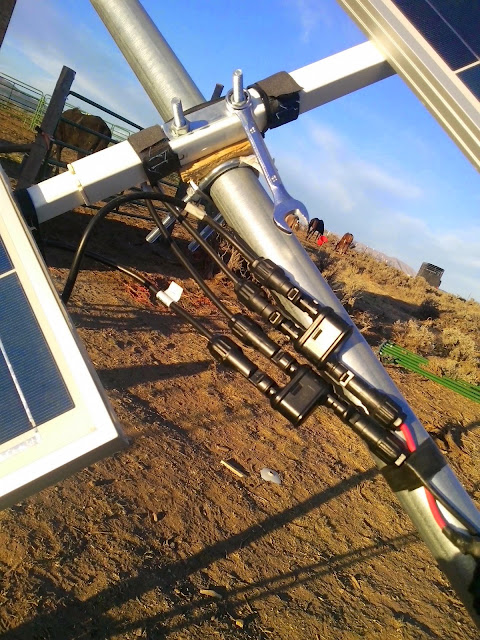


MC4 connections with Y-adapters to "combine" the power from the panels.
Pictured at right is a close-up of the azimuth adjuster, (presently manually operated), and the MC4 connectors, wired in parallel, that bring all the electricity from the PV panels to the batteries. Wiring the panels in parallel allows us to double the amperage while keeping the voltage suitable for charging our 12v battery bank.  I'm by no means an electrical engineer, but that's how Dubs told me it works.

 In the photograph below, we see the top of the solar panel mount, where the azimuth pole is attached with hinges.  The azimuth pole is designed to rotate multi-dimensionally, taking into account the varying elevation of the sun (depending upon the time of year), in order to achieve maximum solar gain.  This portion of the panel mount has to be exceptionally strong and reinforced, as it bears the largest portion of the load when the winds kick up.
 
Top of mounting post.

The photograph below depicts the opposite end of the azimuth pole.  It was constructed out of two poles that were salvaged from an old polo tent that had been decimated beyond recognition in one of our frequent "wind storms".  Dubs salvaged what he thought he could use from the tent, and, the next thing I knew, the poles were accommodating the solar panels while simultaneously providing for elevation adjustments based upon summer, fall/spring, and winter sun elevation angles. The varying settings on the salvaged tent poles are nearly perfect for adjusting the elevation, given the fact that the sun is almost directly overhead during the long days of summer, and just above the horizon during the shorter winter days. During the spring and fall seasons, the trajectory of the sun falls somewhere in between these two extremes.  When solar panels are aimed directly perpendicular to the sun's rays, it is possible to achieve up to 50% more solar gain. Consequently, we have placed a strong emphasis on solar tracking.  This is like a "buy two, get one free" deal and is an obvious no-brainer when it comes to maximizing our power budget.  The solar panels are adjusted multiple times throughout the day to properly align with the position of the sun.  While to some people this would seem to be an inordinate amount of trouble, the fact is, we're outside for much of the day, feeding animals, building and repairing things, etc., so it's really no additional effort to adjust them as we pass by. 
 
If you look at the above picture that shows our current solar array, on the panel that is on the top, in the lower-right corner of the panel, there is a 1 1/2" diameter pipe mounted to align with both edges of the panel.  If the panel is out of alignment, the pipe will cast an oblong shadow.   When the panels are in perfect alignment, the pipe casts a very vague, perfectly circular shadow.  Another amazing Dubs invention!
 
 
The "legs" of the PV solar panel array.   This allows us to adjust the elevation of the panels for the changing seasonal angle of the sun four times a year. 
 
 
Here's another toy we picked up at the new Tractor Supply Company that just opened in Alamosa.  It's a digital thermometer, mounted on our north-facing kitchen window, that tracks the minimum and maximum daily temperature.  On its first night in use, it recorded a low of  24 degrees.  Thankfully, with the recent installation of our Propane Tank Wood Stove, we were toasty warm all night!  Today's high was a balmy 71 which, combined with cloudless skies, provided a limitless, free supply of electricity!


The new thermometer
 
Until next time, Horsey Dreams and Chardonnay Kisses!  Love you my friends!

Sunday, October 5, 2014

Every Pioneer Girl Needs a Knife (or two)

My new toys


Watch out, world...this pioneer girl has a knife!  Dubs surprised me today with a pair of Cowgirl Up Shrade knives, complete with bling and everything!  From cutting baling twine to slaying bobcats, I have no doubt they will get put to good use!
It's been a wonderful weekend down here at Wolf Skull Ranch.  As per the norm, several of my "kids" came down to enjoy the crisp autumn air, the changing aspens, and the gorgeous scenery...not to mention the camaraderie and good cheer.   We started out the weekend with a typical sagebrush bonfire, and are ending it with elk steaks on the barbecue.
The days are getting shorter, the nights are getting colder, and we have snow on Blanca Peak.  The "Little Furnace that Could" continues to keep us toasty warm, maintaining an average evening trailer temperature of 82 degrees.  Last night, we actually had to open the windows, as the thermostat was approaching 93 degrees!  With every night that passes, I become a little bit more familiar with this tiny oven, learning exactly how much wood to put in and how often, to keep the trailer at a comfortable temperature all night long.  
Meanwhile, the solar panels continue to generate mad energy, keeping our batteries charged at 14.4 volts around the clock, despite the fact  that we are constantly charging our cell phones and laptops, leaving the lights on in the evening, etc.  
 
The coming week promises to be busy, between building an earth bag cistern building, hauling hundreds of gallons of water, perfecting the azimuth tracking system on our solar panels, etc.
 
I promise to post more pics soon.
Til tomorrow, Horsey Kisses and Chardonnay Dreams


Friday, October 3, 2014

The Little Furnace That Could. Propane Tank Converted to Wood Burning Stove a Sizzling Success

After a grueling 24 hour test run, (which included me staying up until 4:00 a.m, constantly monitoring the wood burning stove while the others slept*), it is safe to say that Dubs' invention was a rousing success. 

Some amazing facts about this "Little Furnace That Could":

1.  It started out as an old, used propane tank.  After two days of grinding and welding, Dubs and Roy transformed it into the heating beast that it now is.

2.  Despite its diminutive size, and resemblance to a pig (we're considering painting it pink and adding a curly-q metal "tail"), it can maintain a temperature of 450+ degrees for over 120 minutes, fueled only by (relatively) small amounts of timber and sagebrush.

3.  Temps outside last night fell below 31° while our little furnace maintained an overall temperature of 74° in the trailer.

In short, this tiny wood stove can put out some serious heat.  Our smoke detectors and C O monitor have yet to go off, attesting to the completely brilliant ventilation/exhaust system that Dubs so carefully implemented. 

The brisk winds of autumn, the rapidly changing aspens, and fresh snow on Blanca Peak have served to remind us that winter is on its way.  

The dogs, (including Mama Sweety and her pups), are warm and cuddly; the cats are nestled like peas in a pod in their third story "loft", and the horses are starting to look like wooly mammoths.   I have a feeling we're all going to be ok...

Thanks, Dubs.

*Disclaimer: I usually stay up until 4 a.m. anyways, and Dubs doesn't mind when I sleep past noon.  Our opposing sleep schedules actually help us to maintain a 24 hour watch system.